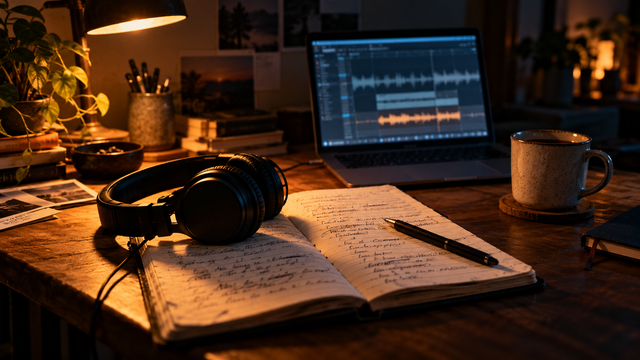
I didn’t set out to start a music project. Hell, I didn’t even set out to make music.
I was scrolling through TikTok one night because I couldn’t sleep when I came across an ad for Suno. I’m an IT Engineer by trade, and AI is getting thrown around in the industry like Tootsie Rolls at a Christmas in July parade, so I figured it might be an interesting way to experiment with prompting and get a better feel for how these systems worked.
Music just happened to be the playground.
I’ve always loved music as a listener. I tried writing a little when I was younger, with very questionable results. I can’t play an instrument, and I wouldn’t pretend I know how to compose a song, but Suno caught my attention, so I decided to see what it could do.
At first, I mostly generated stupid songs to annoy my kids or embarrass them in the car pickup line. Important artistic work. Eventually, though, I started writing more of the material myself. Most of it began closer to poetry than lyrics. I’d write something, paste it into Suno, tweak the prompt, and suddenly it came back sounding... listenable.
I wasn’t sitting there thinking, “I make music now.” I was just having fun. The more I experimented, the more I wrote. I started learning about rhyme schemes, cadence, hooks, and how small changes in a prompt could completely change the feel of a song. Before long, I had enough material to put together an album.
A lot of those early songs were basically journal entries disguised as music. They came from personal experiences, frustrations, mistakes, relationships, and things I probably hadn’t spent much time saying out loud. Writing them was surprisingly cathartic.
Then I made the mistake of reading what people thought about AI-generated music, and there was a lot of hate. Some of the criticism I understood, and some of it I even agreed with. But because some of what I had written was personal, I started worrying less about whether people would like the songs and more about what they would think of me for making them in the first place.
So I kept them to myself and, for a while, mostly stopped. Except I never really stopped. I still listened to the songs in the car, played around with ideas, and kept making ridiculous songs to annoy my kids.
Eventually, I let someone close to me hear some of what I had been working on. To my surprise, they liked it. More importantly, some of it actually resonated with them.
That gave me enough confidence to share a few songs with other people, and I got similar reactions. I didn’t suddenly think I was the next big artist waiting to be discovered. I still don’t. But realizing that something I wrote could connect with somebody else gave me enough reason to keep going.
Somewhere along the way, the whole experiment also started teaching me more about AI than I expected. I got better at prompting, understanding how context changes results, and figuring out how to break larger ideas into smaller pieces.
That started carrying over into my actual job. As more AI tools showed up at work, a lot of the concepts already felt familiar, and I was able to apply some of what I had learned experimenting with music to real workflows and projects. I started messing around with music partly because I wanted a fun way to learn about AI. Somehow, it ended up making me better at my job too.
Once I was having fun again, I started branching out into different styles. My taste in music has never stayed in one lane, so I began experimenting with the kinds of music I already enjoyed listening to. That changed the way I listened.
I’ve always been the type of person who listens to a new album while following along with the lyrics on Genius. But now I was paying attention to different things. I started wondering why certain choruses worked, why one vocal delivery fit a song better than another, and what actually made a genre feel like itself. Songs I had heard dozens of times suddenly had little details I had never noticed before, and once I noticed them, I wanted to experiment with them.
I’m still not going to call myself a musician. I don’t have formal music training, and I’m not pretending that experimenting with AI suddenly gave me a music degree. I just really enjoy music, and I really enjoy technology. This happened to land directly in the middle of that Venn diagram.
There was still one problem, though. I was afraid to actually put any of it out there. Eventually I had a realization:
Who cares?
Seriously. Nobody is being forced to listen to any of this. Nobody has to like it. If someone hates AI-generated music on principle, that’s completely fine. Don’t listen to it.
Maybe somebody else hears a song and enjoys it. Maybe a line connects with them. Maybe they throw it on in the car. Maybe they listen once, decide it isn’t for them, and move on. All of those outcomes are fine.
I’d spent so long worrying about publishing the music that eventually, doing it felt like the only way I was going to get over the fear. Otherwise, I was letting imaginary critics make the decision for me.
So, screw it.
I’m going to put it out there.
I haven’t published anything yet, but for the first time, that’s no longer because I’m afraid to. Now I’m figuring out how I actually want to do it, and somewhere in that process, I realized I had another problem.
By this point, I wasn’t only making one kind of music. Some ideas sounded completely different from others. They didn’t all belong under the same artist name, and trying to force them together didn’t make much sense. Different styles needed different voices, and different ideas needed different identities.
Eventually, I realized I needed somewhere for all of it to live. That’s where ZakoSound came from.
Not because I suddenly decided I wanted to start a record label, but because I wanted a home for the different sounds, styles, ideas, and projects I wanted to explore. Each project can have its own voice and identity, and whatever I decide to experiment with next can have a place too.
That’s really what ZakoSound is: a home for all of it.
Some of it may be serious. Some of it may be weird. Some of it may never make it past the experiment stage, and some of it might turn into something I’m proud enough to share. I still don’t know exactly where all of this goes, but at least now I’m willing to find out.